General Types of Tenancies
Understanding the Different Ways Property Can Be Occupied
Introduction
In the previous article, we discussed the basics of the landlord-tenant relationship and how a tenancy is created. However, not all tenancies are the same.
The duration of occupation, the terms agreed between the parties, and the manner in which possession is given can result in different types of tenancies. Understanding these differences is important because the rights and obligations of landlords and tenants often depend upon the type of tenancy involved.
This article explains the most common types of tenancies in simple language.
What is a Tenancy?
A tenancy is an arrangement under which a landlord allows a tenant to occupy and use a property in return for rent.
The nature of this arrangement determines the type of tenancy.
General Tenancies:
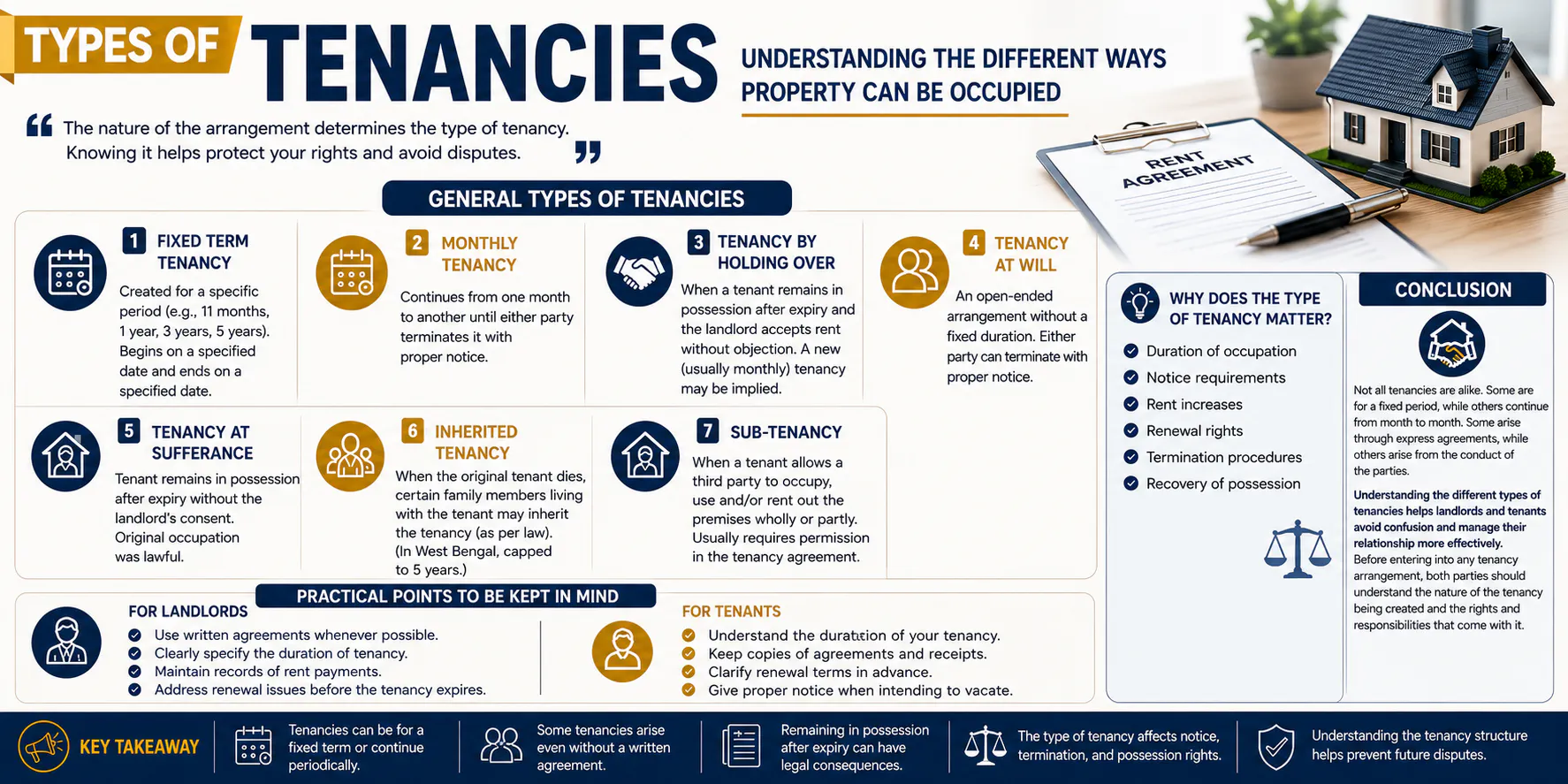
1. Fixed Term Tenancy
A fixed term tenancy is created for a specific period.
Example:
a. 11 Months
b. 1 Year
c. 3 Year
d. 5 Year or so
Such tenancy begins on a specified date and ends on a specified date.
2. Monthly Tenancy
A Monthly tenancy continues from one month to another until either party terminates it according to law.
If the rent is paid every month and there is no fixed date of determination of the tenancy it is often treated as monthly tenancy.
Many tenancies operate in this manner after the expiry of the fixed term tenancies.
It continues automatically from month to month and can be terminated by giving proper notice.
3. Tenancy by Holding Over
A tenancy by holding over is created when a tenant remains in the possession of the tenanted property even after the expiry of the tenancy and the landlord continues to accept the rent from the tenant.
In such cases, the law may treat the conduct of the parties as creating new tenancy, often a monthly tenancy.
Example:
Suppose a tenancy was created on April 1st, 2025 and expired on March 31st, 2026. The landlord continues to accept the rent from the tenant from April 1st, 2026 without objection, a Tenancy by Holding Over is created.
Key Features:
· Tenant remains in possession after expiry of the tenancy
· Landlord accepts the rent without objection
· A new tenancy may be implied.
4. Tenancy at will
A Tenancy at Will is a kind of open-ended arrangement where a tenant resides with the consent of the Landlord but without any formal written agreement. Either the landlord or tenant can terminate the same by giving a notice in conformity with the prevailing laws. These types of tenancies are sometimes similar to monthly tenancies.
Key Features:
· Flexible arrangement and does not define the rental duration or specifies rental exchanges.
· It allows the tenancy to be terminated any time either by landlord or the tenant.
· Generally speaking, notice to terminate is required with a notice period of 30 days.
· It generally ends automatically if the tenant or the landlord dies.
5. Tenancy at Sufferance
This type of tenancy arises where a tenant is inducted in the property lawfully but remains in the possession of the premises even after the expiry of the tenancy agreement without the consent of the landlord.
A Tenant originally entered into a premises lawfully but continues the possession without the consent of the landlord.
Example:
Say, a Tenant was inducted in a premises on April 1st, 2020, the tenancy expired on March 31st, 2026. The landlord did not consent to the further arrangement of the tenancy nor he accepted any rent from tenant after such expiry. In such case, tenancy at sufferance is created. It shall be pertinent to mention that there is a very thin line difference between a “trespasser” and a “tenant at sufferance”. A trespasser is not inducted lawfully but the “tenant at sufferance” is inducted lawfully.
Key Features:
· Original occupation by the tenant was lawful.
· Continued occupation by such tenant after the expiry of the tenancy is without fresh consent of the landlord.
Such situation often occurs when parties fail to discuss renewal of the tenancy.
6. Inherited Tenancy
Inherited tenancy is created when the original tenant dies during subsisting of the tenancy and his/her spouse, son, daughter, parent and the widow of his predeceased son, who were ordinarily living with the tenant up to the date of death of the tenant, but such tenancy as per the West Bengal Premises Tenancy Act, 1997 is capped to a period of 5 Years from the date of death of the tenant or from the date of coming into force of the West Bengal Premises Tenancy Act, 1997.
Example:
Say, a tenancy was created on April 1st, 2020 and the tenant dies on December 1st, 2020. His spouse was living at the date of the tenant’s death with him; in such a situation the spouse inherits the tenancy for a period of 5 Years from the date of death of the tenant.
Now, The West Bengal Premises Tenancy Act, 1997 came into force on July 10th, 2001, say in the above situation the tenancy was created in the year April 1st, 2000 and the tenant dies on December 1st, 2000, under such situation the 5 Years under such inherited tenancy shall be calculated from July 10th, 2001.
7. Sub-Tenancy
A Sub-Tenancy occurs when a Tenant allows someone else to occupy, use and/or rent out the originally tenanted premises by the him/her either partly or fully to another person.
Key Features:
· A tenant inducted by the original landlord inducts a third party to the same premises.
· Often the agreement between the original tenant and the original landlord should empower and/or give authority to the original tenant to induct a sub-tenant.
Why Does the Type of Tenancy Matter?
The type of tenancy affects several important issues, including:
- Duration of occupation;
- Notice requirements;
- Rent increases;
- Renewal rights;
- Termination procedures;
- Recovery of possession by the landlord.
Knowing the nature of the tenancy helps both parties understand their legal position.
Practical Points to be kept in mind for Landlords and Tenants
For Landlords
- Use written agreements whenever possible.
- Clearly specify the duration of tenancy.
- Maintain records of rent payments.
- Address renewal issues before the tenancy expires.
For Tenants
- Understand the duration of your tenancy.
- Keep copies of agreements and receipts.
- Clarify renewal terms in advance.
- Give proper notice when intending to vacate.
Conclusion
Not all tenancies are alike. Some are for a fixed period, while others continue from month to month. Some arise through express agreements, while others arise from the conduct of the parties.
Understanding the different types of tenancies helps landlords and tenants avoid confusion and manage their relationship more effectively. Before entering into any tenancy arrangement, both parties should understand the nature of the tenancy being created and the rights and responsibilities that come with it.
These were some general types of tenancies that we come across in daily lives, diving deeper into the topic there are other types of tenancies also such as “Thika Tenancy”, “Co-Tenancy”, “Perpetual Tenancy” and so on.