Rent Agreement
Why does it matter, what should every Landlord & Tenant should know
Introduction
In the previous articles, we discussed the landlord-tenant relationship and the different types of tenancies. Once a landlord decides to let out a property and a tenant agrees to occupy it, the next important step is documenting the arrangement.
This is where a Rent Agreement becomes important.
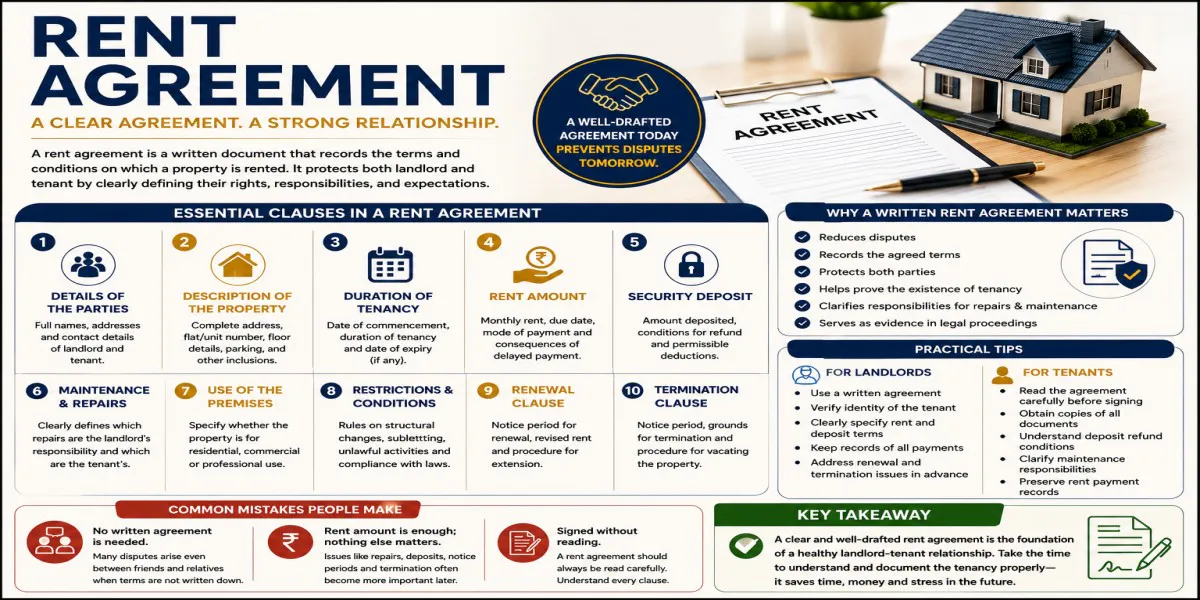
A well-drafted rent agreement protects both the landlord and the tenant by clearly defining their rights, responsibilities, and expectations. Many disputes can be avoided simply by having a clear written agreement.
This article explains the importance of rent agreements and the essential clauses that every landlord and tenant should understand.
What is a Rent Agreement?
A rent agreement is a written document that records the terms and conditions on which a property is rented.
It serves as evidence of the arrangement between the landlord and the tenant and helps avoid misunderstandings in the future.
Simply put, a rent agreement answers the basic questions:
- Who is the landlord?
- Who is the tenant?
- Which property is being rented?
- How much rent is payable?
- For how long can the tenant occupy the property?
- What are the rights and obligations of both parties?
Why is a Written Rent Agreement Important?
Many people still rely on verbal promises and informal arrangements. While trust is important, a written agreement provides clarity and certainty.
A written rent agreement:
- Reduces disputes.
- Records the agreed terms.
- Protects both parties.
- Helps prove the existence of tenancy.
- Clarifies responsibilities regarding repairs and maintenance.
- Serves as evidence in case of legal proceedings.
A properly drafted agreement often prevents problems before they arise.
Essential Clauses in a Rent Agreement
1. Details of the Parties
The agreement should clearly identify:
- The landlord;
- The tenant;
- Their addresses and contact details.
Incorrect or incomplete details can create complications later.
2. Description of the Property
The property being rented should be properly described.
The agreement should mention:
- Complete address;
- Flat or unit number;
- Floor details if applicable;
- Parking space, if included.
There should be no confusion regarding the premises being rented.
3. Duration of Tenancy
The agreement should clearly state:
- Date of commencement;
- Duration of tenancy;
- Date of expiry, if any.
This helps both parties understand the expected length of occupation.
4. Rent Amount
The agreement should specify:
- Monthly rent;
- Due date for payment;
- Mode of payment;
- Consequences of delayed payment.
Clear rent provisions help avoid future disagreements.
5. Security Deposit
Many landlords require a security deposit before handing over possession.
The agreement should clearly mention:
- Amount deposited;
- Conditions for refund;
- Permissible deductions, if any.
Both parties should understand how and when the deposit will be returned.
6. Maintenance and Repairs
One of the most common causes of disputes relates to repairs.
The agreement should clarify:
- Which repairs are the landlord's responsibility;
- Which repairs are the tenant's responsibility;
- Who will bear maintenance charges.
Clear allocation of responsibilities reduces future conflict.
7. Use of the Premises
The agreement should specify the permitted use of the property.
For example:
- Residential use;
- Commercial use;
- Professional use.
A residential property should generally not be used for unauthorized commercial activities.
8. Restrictions and Conditions
Certain restrictions may be included, such as:
- No structural alterations;
- No unlawful activities;
- Restrictions on subletting;
- Compliance with building rules and regulations.
These conditions help maintain order and protect the property.
9. Renewal Clause
The parties should decide in advance whether the tenancy may be renewed.
A renewal clause may specify:
- Notice period for renewal;
- Revised rent upon renewal;
- Procedure for extending the tenancy.
Discussing renewal beforehand often avoids uncertainty.
10. Termination Clause
Every rent agreement should provide a mechanism for termination.
The agreement should specify:
- Notice period;
- Grounds for termination;
- Procedure for vacating the property.
A clear termination clause protects both parties from unnecessary disputes.
Registration of Rent Agreements
Depending on the applicable law and the duration of tenancy, registration may be required or advisable.
Registration provides additional authenticity and evidentiary value to the agreement.
Landlords and tenants should verify the legal requirements applicable in their State before executing a tenancy arrangement.
Common Mistakes People Make
"We know each other, so no written agreement is needed."
Many disputes arise between friends, relatives, and acquaintances because important terms were never written down.
"The rent amount is enough; nothing else matters."
Rent is only one aspect of the tenancy. Issues relating to repairs, deposits, notice periods, and termination often become more important later.
"I signed without reading."
A rent agreement should always be read carefully before signing.
Both parties should understand every clause.
Practical Tips for Landlords
- Use a written agreement.
- Verify the identity of the tenant.
- Clearly specify rent and deposit terms.
- Keep records of all payments.
- Address renewal and termination issues in advance.
Practical Tips for Tenants
- Read the agreement carefully before signing.
- Obtain copies of all documents.
- Understand the deposit refund conditions.
- Clarify maintenance responsibilities.
- Preserve rent payment records.
Conclusion
A rent agreement is more than just a piece of paper. It is the foundation of a healthy landlord-tenant relationship.
A clear and well-drafted agreement protects both parties, reduces misunderstandings, and provides certainty regarding their rights and obligations. Whether you are a landlord or a tenant, taking the time to understand and document the tenancy properly can save considerable time, expense, and stress in the future.
Key Takeaways
- Always insist on a written rent agreement.
- Clearly define rent, deposit, duration, and notice periods.
- Read every clause before signing.
- Keep copies of agreements and payment records.
- A well-drafted agreement prevents most tenancy disputes.