Streedhan & Women's Inheritance Rights
What Every Hindu Woman Should Know
Know Your Rights Before You Need Them
Many people believe that everything a woman receives after marriage belongs to her husband's family, or that daughters have fewer rights in family property than sons. These are common misconceptions.
The law gives Hindu women significant rights over their own property and inheritance. Two of the most important concepts are Streedhan and inheritance rights.
Let's understand them in simple terms.
What is Streedhan?
The word Streedhan literally means "a woman's property."
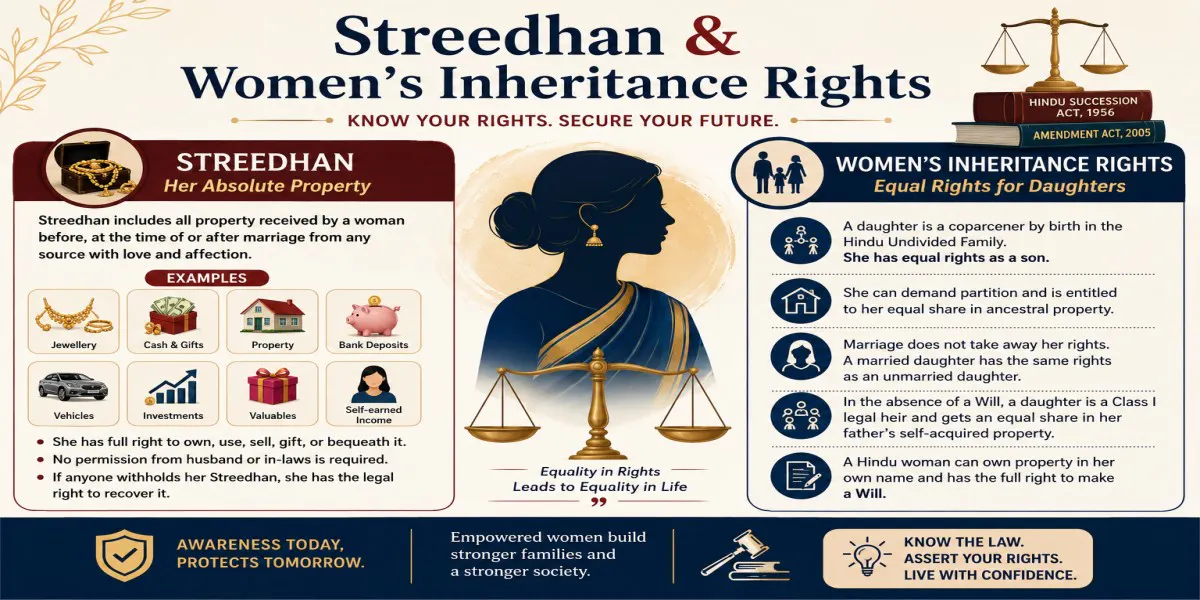
It includes all movable and immovable property that a woman receives:
- Before marriage
- At the time of marriage
- During her married life
- From her parents
- From her husband
- From her in-laws
- From relatives or friends
- By way of gifts, inheritance, purchase, salary, or self-earned income
Examples include:
- Gold and diamond jewellery
- Cash received as gifts
- Bank deposits
- Vehicles
- Property gifted to her
- Investments
- Household valuables gifted exclusively to her
Simply put, if it belongs to the woman, it is her exclusive property.
Does the Husband Have Any Right Over Streedhan?
No.
The husband does not become the owner merely because the woman is married to him.
Even if the jewellery or valuables are kept in the husband's house or in-laws' house for safekeeping, ownership remains with the woman.
If anyone refuses to return her Streedhan, she has the legal right to recover it through appropriate legal proceedings. In certain circumstances, wrongful retention of Streedhan may also attract criminal consequences.
Is Dowry the Same as Streedhan?
Absolutely not.
This is one of the biggest misunderstandings.
Dowry
- Illegal under Indian law.
- Property demanded by the groom or his family as a condition of marriage.
Streedhan
- Legal.
- Voluntary gifts given to the bride out of love and affection.
- The property belongs exclusively to the woman.
The difference lies in whether the property was demanded or voluntarily gifted.
Can a Woman Sell or Gift Her Streedhan?
Yes.
Since Streedhan is her absolute property, she may:
- Sell it
- Gift it
- Mortgage it
- Donate it
- Bequeath it through a Will
No permission from her husband or in-laws is required.
Women's Inheritance Rights Under Hindu Law
The Hindu Succession Act, 1956, as amended in 2005, brought about a landmark change in women's property rights.
Today, daughters enjoy rights that are equal to sons in many respects.
A Daughter is Equal to a Son in Ancestral Property
A Hindu daughter is a coparcener by birth in a Hindu Undivided Family (HUF).
This means:
- She has the same birthright as a son.
- She can demand partition.
- She can inherit her share.
- She can dispose of her share according to law.
These rights exist whether she is married or unmarried.
Marriage does not take away her rights in ancestral property.
Rights in Father's Self-Acquired Property
If a father dies without leaving a Will, his self-acquired property is inherited according to the rules of succession.
Generally, his Class I legal heirs inherit simultaneously, including:
- Widow
- Son
- Daughter
- Mother (if living)
Each is entitled to an equal share, subject to the facts of the particular case.
Can a Married Daughter Inherit?
Yes.
Marriage does not extinguish a daughter's inheritance rights.
A married daughter has the same legal right to inherit as an unmarried daughter.
Can a Hindu Woman Own Property in Her Own Name?
Certainly.
A Hindu woman may:
- Purchase property
- Receive property by gift
- Inherit property
- Earn property through her profession or business
- Receive property under a Will
Such property belongs exclusively to her.
Can She Make a Will?
Yes.
A Hindu woman has every right to execute a Will for her own property, including her Streedhan and any other assets owned by her.
Common Myths vs Reality
Myth: Jewellery given after marriage belongs to the husband's family.
Reality: It remains the woman's Streedhan unless she voluntarily transfers ownership.
Myth: A married daughter cannot inherit her father's property.
Reality: A married daughter enjoys the same inheritance rights as a son under Hindu law.
Myth: A woman cannot sell family gifts without her husband's consent.
Reality: If the gifts constitute her Streedhan, she is the absolute owner.
Myth: Sons have greater inheritance rights than daughters.
Reality: The law grants daughters equal rights in ancestral property and equal succession rights in applicable cases.
Why Knowing These Rights Matters
Property disputes often arise because people rely on tradition instead of the law.
Understanding the distinction between Streedhan and family property, and knowing a woman's inheritance rights, helps families avoid unnecessary disputes and ensures that legal rights are respected.
Awareness is the first step towards protecting one's rights.
Legal Note
This article provides a general overview based on the Hindu Succession Act, 1956 (as amended in 2005) and settled legal principles. Individual cases may differ depending on the facts, the nature of the property, the existence of a Will, family arrangements, or other applicable laws. Legal advice should be sought for specific situations.