Why Women Should Be Financially Independent: Because Independence Is More Than Just Money
"A financially independent woman does not seek permission to dream—she creates opportunities to achieve those dreams."
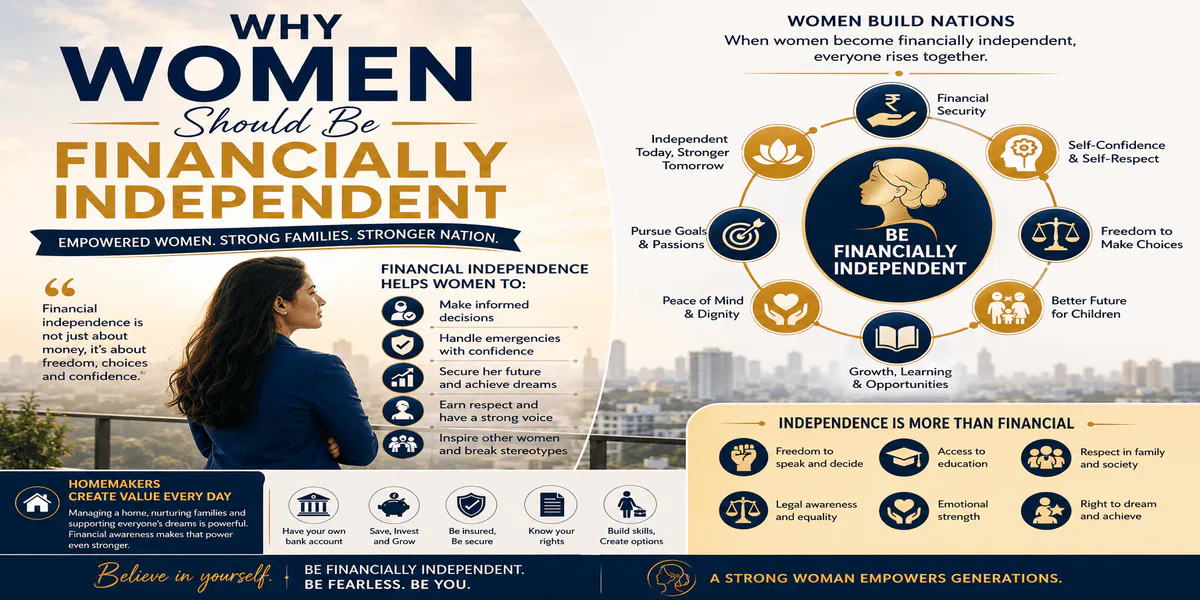
For generations, Indian women have been the backbone of their families. They have nurtured children, cared for elders, managed households, preserved traditions, and often sacrificed their own aspirations for the well-being of others.
Yet, despite their immense contribution, many women were taught that financial decisions belonged to someone else—first their fathers, then their husbands, and later, even their sons.
Fortunately, times are changing.
Today's women are not merely contributing to society—they are leading businesses, shaping policies, serving in the armed forces, arguing before courts, running households, and building successful careers. However, the conversation about financial independence remains more relevant than ever.
The truth is, independence is not only about earning money—it is about having the freedom, confidence, and ability to make one's own choices.
· Understanding Financial Independence
Financial independence does not necessarily mean becoming wealthy.
It simply means having the ability to meet your financial needs without being entirely dependent on someone else.
It gives a woman the confidence to make decisions regarding:
- Her education
- Healthcare
- Career
- Investments
- Children's future
- Retirement
- Personal aspirations
Most importantly, it gives her a voice that is backed by financial confidence.
· Looking Back: The Journey of Indian Women
Historically, women in India faced numerous social and economic barriers.
Many were:
- Denied education.
- Married at an early age.
- Expected to remain homemakers.
- Excluded from financial decisions.
- Discouraged from owning property or pursuing careers.
Despite these challenges, they silently built strong families and stable homes.
Their contribution was rarely measured in salaries, yet it was priceless.
Today's generation stands on the sacrifices made by these women.
Recognising their contribution is as important as celebrating the achievements of modern women.
· The Homemaker: The Most Undervalued Professional
A homemaker does not receive a monthly salary.
Yet every single day she performs multiple roles:
- Household Manager
- Financial Planner
- Child Caregiver
- Teacher
- Nurse
- Nutritionist
- Event Organiser
- Emotional Support System
- Crisis Manager
If these services were outsourced, the cost would be enormous.
A homemaker creates economic value even if it does not appear in a bank account.
Her work enables other family members to pursue education, employment, and business opportunities.
That contribution deserves recognition.
· Should Homemakers Also Be Financially Independent?
Absolutely.
Financial independence for homemakers does not necessarily mean taking up a full-time job.
It can include:
- Having personal savings.
- Maintaining a bank account in their own name.
- Learning financial planning.
- Investing regularly.
- Owning assets.
- Understanding insurance and taxation.
- Knowing family finances.
- Building skills that can generate income if required.
Financial awareness is just as important as financial earnings.
Every homemaker should know where the family's investments are, how bills are paid, and what financial security measures exist.
Knowledge itself is a form of independence.
· Why Financial Independence Matters
Financial independence empowers women to:
Make informed life decisions
Whether it is pursuing higher education, changing careers, or starting a business, financial confidence provides the freedom to choose.
Handle emergencies
Unexpected events such as illness, job loss, or the death of a family member can create financial uncertainty.
A financially aware woman is better prepared to navigate such situations.
Build self-confidence
Earning or managing money often enhances confidence and encourages greater participation in important family decisions.
Secure the future
Savings, investments, insurance, and retirement planning help women remain financially secure throughout different stages of life.
Break social stereotypes
Every financially independent woman inspires another woman to believe that she too can achieve independence.
Independence Is More Than Financial
Perhaps the biggest misconception is that independence begins and ends with money.
It does not.
True independence includes:
- The freedom to express opinions.
- The confidence to make informed decisions.
- Access to quality education.
- The ability to pursue one's ambitions.
- Emotional resilience.
- Freedom from fear.
- Legal awareness.
- Respect within the family and society.
- The ability to say "Yes" or "No" without pressure.
Money can strengthen independence, but it cannot replace dignity, confidence, education, or self-respect.
A truly independent woman is one who can make choices based on her own values and aspirations.
· The Role of Families
Empowering women is not solely a woman's responsibility.
Families play an equally important role.
Parents should educate daughters about money just as they educate sons.
Husbands should view financial decisions as shared responsibilities.
Children should grow up seeing equality at home.
When women are trusted with financial responsibilities, families become stronger and more resilient.
· The Law Also Recognises Women's Rights
Over the years, Indian laws have increasingly recognised women's rights relating to:
- Equal inheritance.
- Ownership of property.
- Streedhan.
- Equal remuneration.
- Maternity benefits.
- Protection against domestic violence and workplace harassment.
Legal rights are meaningful only when women are aware of them and have the confidence to exercise them.
· A Message to Every Woman
Whether you are:
- A student,
- A working professional,
- An entrepreneur,
- A homemaker,
- A mother,
- Or a retiree—
Never stop learning about money.
Open your own bank account.
Understand investments.
Read about financial planning.
Know your legal rights.
Build skills.
Keep growing.
Because independence is not measured by the size of your income—it is measured by the strength of your choices.
· Conclusion
Women have always been the foundation of Indian families. Yesterday's women carried society forward through sacrifice. Today's women are transforming society through education, leadership, entrepreneurship, and professional excellence.
The journey from dependence to independence is not merely financial—it is intellectual, emotional, social, and legal.
A financially independent woman strengthens not only herself but her family, her community, and the nation.
As India progresses towards greater equality, empowering women with financial knowledge, legal awareness, and confidence is not just a personal goal—it is a national necessity.
Because when a woman becomes independent, generations become empowered.
*Legal & Educational Note
This article is intended for public awareness and educational purposes. Financial independence is a personal journey and may look different for every woman depending on her circumstances. The objective is not to diminish the invaluable role of homemakers or traditional family structures, but to encourage financial literacy, legal awareness, informed decision-making, and equal opportunities for every woman.